
What Happens to Pharmaceuticals When They’re Left Exposed on the Tarmac?
Pharmaceutical shipments can spend hours being carefully prepared, packed, and transported under controlled conditions. However, once they reach an airport, there’s one part of the journey that can introduce a very different kind of risk: the tarmac.
Unlike a temperature-controlled warehouse or cargo terminal, an airport apron exposes shipments to outdoor conditions, direct sunlight, and heat radiating from the ground. In the UAE, where summer conditions can be particularly challenging, this can place additional thermal stress on temperature-sensitive healthcare products.
But what actually happens to pharmaceuticals when they are left exposed on the tarmac?
The answer depends on the product, packaging, and duration of exposure. However, the potential consequences can range from temperature excursions to reduced product stability.
Table of Contents
- Delays Can Reduce the Shipment's Available Protection Window
- Why Tarmac Exposure is Particularly Important in the UAE
- How Can Pharmaceutical Shipments be Protected on the Tarmac?
- How TFI helps Protect Healthcare Shipments
- Partner with TFI and Safeguard Your Pharmaceutical Cold Chain from Tarmac Exposure
- Frequently Asked Questions
#1 Product Temperatures Can Move Outside Their Required Range
The most immediate concern is a temperature excursion.
When a shipment is left in a hot outdoor environment, heat gradually transfers through the packaging. If the packaging system cannot maintain the required internal conditions for the duration of exposure, the product temperature can move outside its approved range.
This doesn’t necessarily happen immediately. The rate of temperature change depends on factors such as the packaging design, payload, phase change material (PCM) configuration, ambient conditions, and exposure time.
But the longer a shipment remains exposed, the harder it becomes to maintain the required temperature.
#2 Excessive Heat Can Affect Product Stability
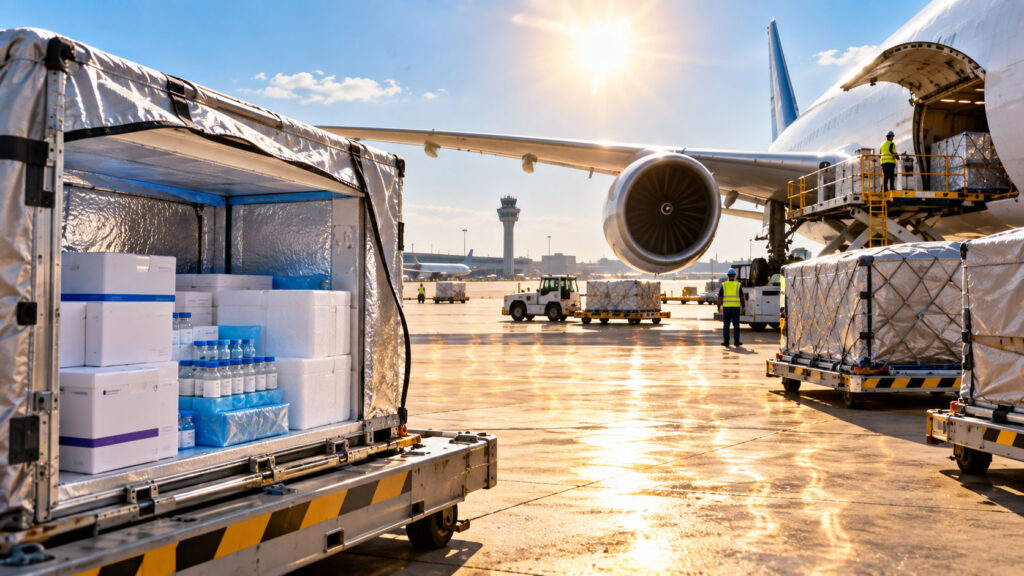
A pharmaceutical product can be affected by heat even when there’s no visible sign of damage.
Some medicines and biological products are sensitive to temperature changes because their chemical or biological stability can be affected by excessive thermal exposure. Depending on the product and the severity of the exposure, this may contribute to degradation or loss of potency.
The risk varies significantly between products, which is why pharmaceutical shipments should always be handled according to their specific storage and transportation requirements.
A vial that looks completely normal after delivery doesn’t necessarily confirm that its temperature history was acceptable.
#3 Passive Packaging Can Lose Its Thermal Protection
Passive packaging is designed to protect the payload by controlling the temperature inside the shipper for a validated period. However, it has a finite thermal capacity.
When a passive shipper is exposed to intense external heat, its insulation and PCM system have to absorb that thermal energy. If exposure continues beyond the conditions or duration for which the system was qualified, the available thermal protection can eventually be exhausted.
Once the packaging can no longer maintain the required internal environment, the payload becomes increasingly vulnerable to external heat.
This is why a packaging system should be selected based on the actual shipment profile rather than relying solely on a stated protection duration.
#4 Direct Sunlight Can Increase Thermal Stress
Heat on the tarmac isn’t only about air temperature.
Direct solar radiation can significantly increase the thermal load experienced by cargo. Dark or exposed surfaces can absorb solar energy, while the hot apron surface can transfer additional heat to cargo positioned nearby. This creates a much more demanding environment than the shaded or climate-controlled conditions found inside an airport terminal.
Therefore, reducing direct exposure of temperature-sensitive pharmaceuticals during loading, unloading, and ground transfers is a critical part of cold chain protection.
#5 Repeated Short Exposures Can Add Up
The tarmac risk isn’t necessarily limited to one long delay.
A shipment may experience several short periods of exposure while being unloaded from an aircraft, transferred between handling areas, loaded onto a vehicle or moved into a cargo terminal. Each exposure introduces additional thermal stress.
Even when individual periods are relatively brief, repeated fluctuations can contribute to the shipment’s overall thermal exposure. This is why cold chain planning needs to consider the complete movement of the shipment rather than focusing only on flight time.
#6 Temperature Excursions Can Trigger Product Investigations
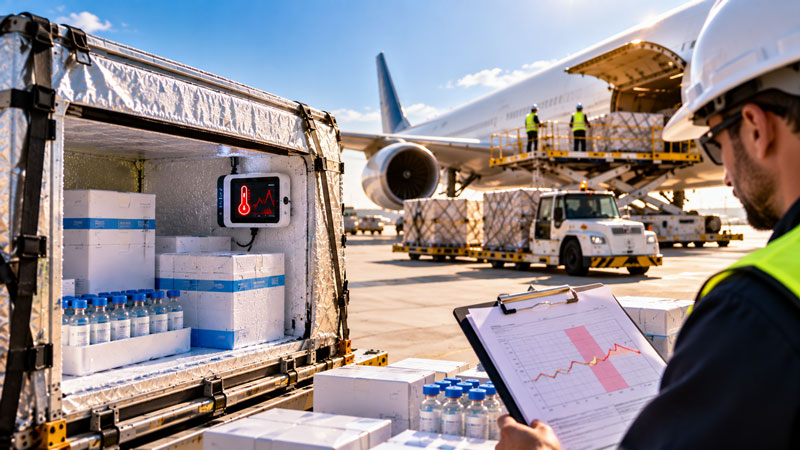
If a shipment is exposed to temperatures outside its specified range, the situation may require a documented temperature excursion investigation.
Temperature data can help establish what happened, including the temperature reached, how long the exposure lasted and when the deviation occurred.
The product should not automatically be considered unusable simply because an excursion occurred. The appropriate quality team or product owner needs to assess the exposure against the product’s stability information and applicable procedures.
For logistics teams, accurate monitoring and documentation are, thus, essential.
#7 Delays Can Reduce the Shipment’s Available Protection Window
Every passive packaging system has a defined protection capability.
An unexpected delay on the tarmac can consume part of that protection window before the shipment reaches the next controlled environment.
For instance, a shipper (passive packaging box) designed and qualified for a specific transit duration may have been planned around a particular route and handling timeline. If the shipment spends considerably longer than expected waiting in an exposed environment, the remaining protection margin may be reduced.
This is why contingency planning should form part of the original transport plan rather than being considered only after a delay occurs.
Why Tarmac Exposure is Particularly Important in the UAE

The UAE presents additional challenges for temperature-sensitive healthcare logistics because of its hot ambient conditions, particularly during the summer months.
A shipment moving through a climate-controlled cargo facility can encounter a very different environment when it is transferred outdoors for loading or unloading.
Hence, the transition between controlled and uncontrolled environments is an important part of the cold chain to consider.
A robust Lane Risk Assessment should account for these points of exposure and identify appropriate controls for each stage.
How Can Pharmaceutical Shipments be Protected on the Tarmac?
Preventing unnecessary exposure starts with planning.
The packaging system should be selected and configured according to the product’s temperature requirements, payload, and expected journey. Where passive packaging is used, it should be appropriately validated for the intended conditions and transit duration.
During airport handling, shipments should be protected from direct environmental exposure wherever possible. Temperature-controlled ground handling, suitable thermal protection, and efficient coordination between cargo handlers and transport teams can help reduce the time a shipment spends in challenging conditions.
Temperature monitoring adds another layer of protection. Historical data can document the shipment’s temperature history, while real-time monitoring can provide visibility while the shipment is still in transit. If a temperature trend begins moving in the wrong direction, your logistics provider has an opportunity to investigate and determine whether intervention is required.
How TFI helps Protect Healthcare Shipments
Avoiding tarmac-related temperature risks requires more than simply using insulated packaging.
At TFI, our healthcare logistics operations combine route planning, risk assessment, temperature-controlled handling, validated passive packaging, and temperature monitoring to help protect temperature-sensitive shipments throughout their journey.
As a GDP-certified healthcare logistics provider, we handle pharmaceutical, biopharmaceutical, clinical trial and medical shipments with processes designed around their specific temperature and handling requirements. Before a shipment moves, we assess potential risks along the journey, including exposure points during airport handling and ground transfers.
Where passive packaging is required, the packaging configuration is selected based on the shipment’s temperature range, payload, and transport requirements. During ground handling, our careful coordination helps minimize the time temperature-sensitive cargo spends in uncontrolled conditions. We also ensure appropriate handling to provide protection when unexpected delays occur.
Moreover, we have a robust temperature monitoring system in place that provides visibility throughout the journey. It helps track shipment conditions and supports timely action when a potential deviation needs attention. Together, these measures help reduce unnecessary exposure and maintain cold chain integrity from origin through to final delivery.
Partner with TFI and Safeguard Your Pharmaceutical Cold Chain from Tarmac Exposure
A pharmaceutical shipment may spend only a small part of its journey outside a controlled environment, but that short period can become a significant risk when high heat, direct sunlight, and unexpected delays come together.
The key is to treat airport ground handling as an integral part of the cold chain, not simply a transition between the aircraft and the next vehicle.
With appropriate validated passive packaging, route planning, monitoring, and controlled handling, pharmaceutical shipments can be better protected from unnecessary thermal exposure.
Speak with TFI’s healthcare logistics team to discuss your shipment requirements. We’ll help you find the right logistics approach and develop a tailored cold chain solution for your products.
Responsibility can involve several parties, including the airline, ground handling agent, freight forwarder and consignee. What matters is that responsibilities are clearly defined before the shipment moves. A healthcare logistics provider should coordinate with the relevant parties to ensure temperature-sensitive cargo is handled according to the agreed requirements.
Even a short period outside can introduce additional thermal exposure, particularly in hot climates such as the UAE. Whether the exposure presents a significant risk depends on the product, packaging system, ambient conditions and duration. For this reason, unnecessary outdoor exposure should be minimized and considered during transport planning.
Important information includes the product’s required temperature range, packaging requirements, payload details, origin and destination to estimate transit times, and any specific handling instructions. Providing this information in advance allows the logistics provider to plan the shipment around its actual requirements rather than relying on standard handling procedures.
Check if the provider utilizes a risk-based approach. Consider its GDP processes, temperature-controlled handling capabilities, monitoring systems, packaging options, airport coordination, and experience with temperature-sensitive healthcare products. It’s also useful to understand how the company handles unexpected situations during transit.
Yes. We can work with customers to understand their product, temperature requirements, payload, and transportation needs before recommending the appropriate logistics approach. As a GDP-certified healthcare logistics provider, TFI combines temperature-controlled handling, validated passive packaging, monitoring, and route risk assessment to develop tailored solutions for temperature-sensitive shipments.